
Loading the latest stories…
SUBcast-on
Ready for ribbing? This CO is a game changer.
Sandi Rosner4 min read
The long-tail cast-on is a favorite for many knitters. It creates a stable edge with a row of knit stitches on the needle ready to go. But it’s not the best choice for every project. The long-tail cast-on is notorious for creating a tight edge that impedes the stretchiness of knitting. Let’s take a closer look to find out why.
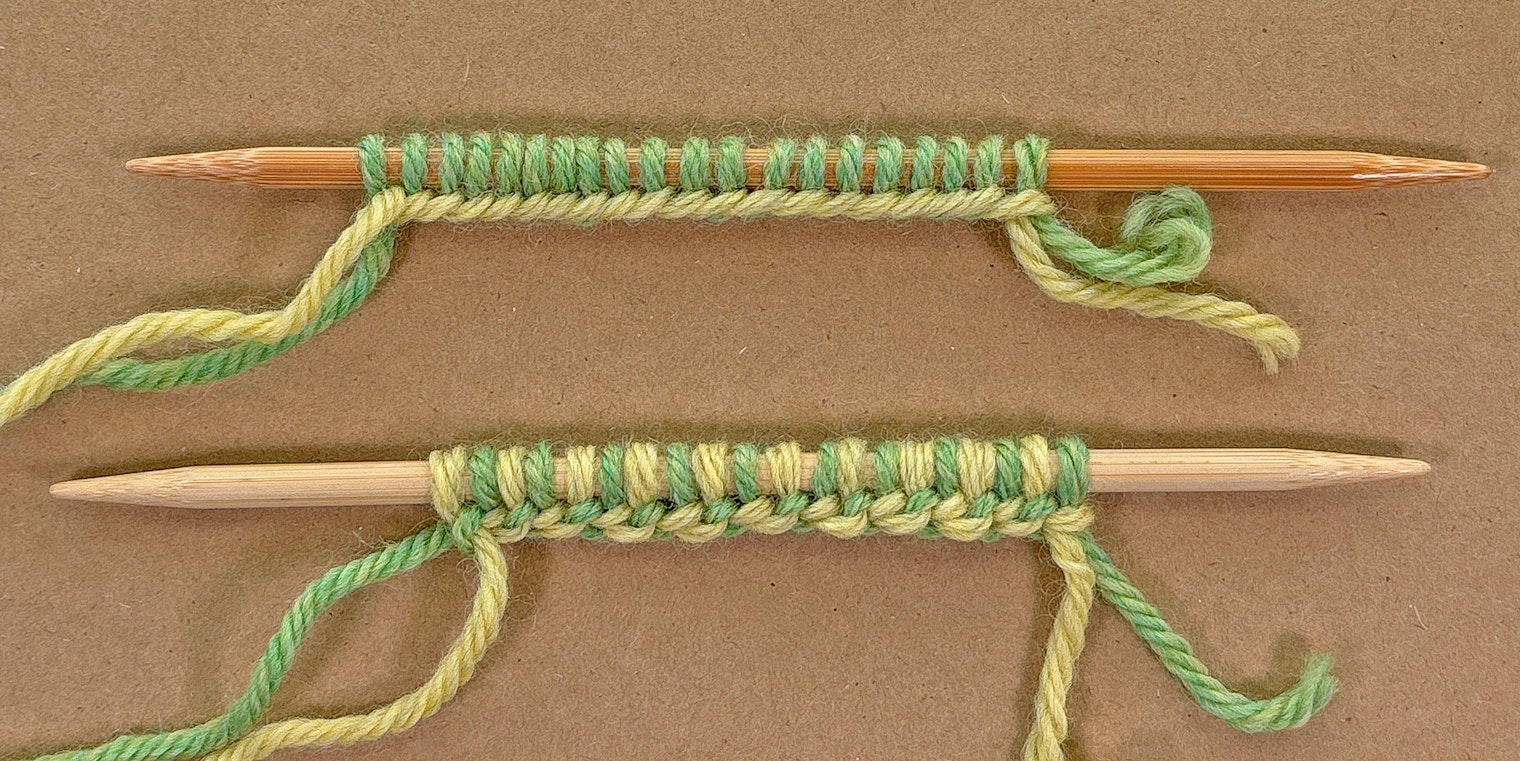
 A standard long-tail cast-on worked in two colors for clarity.
For this example, yellow yarn was used for the “tail” and held over the thumb while casting on. Green yarn was used for the “working yarn” and held over the index finger while casting on. You can see that the working yarn forms the stitches on the needle, while the tail yarn forms a series of foundation loops anchoring each stitch in place.
The path traveled by the tail yarn is much shorter than that traveled by the working yarn. And that tail yarn is what limits the ability of the edge to stretch. You may have been advised to cast on with a bigger needle or with two needles held together to avoid a tight edge. Now you know why that isn’t a good solution. Using a larger needle does not add length to the tail yarn; it simply enlarges the first row of stitches.
 The alternating long-tail cast-on worked in two colors for clarity.
If your project starts with ribbing, an alternating long-tail method might be a perfect fit. As in the previous example, yellow yarn was used for the tail and held over the thumb; green yarn was used for the working yarn and held over the index finger. Knit stitches are formed with the working yarn and purl stitches are formed with the tail. Both strands of yarn travel the same path around the needle, alternating between forming the stitch and forming the foundation loop. This longer path for the tail yarn builds in enough length to allow the edge to stretch as much as the ribbing that will arise from it.
More from Farm & Fiber Knits
From the Library





Comments
No comments yet — be the first to share your thoughts.
Sign in to join the conversation — commenting is for signed-in members.