
Loading the latest stories…
Would you knit a bertha? How about a Roquelare? Discover a cloak by any other name, or many other names.
Pat Olski4 min read
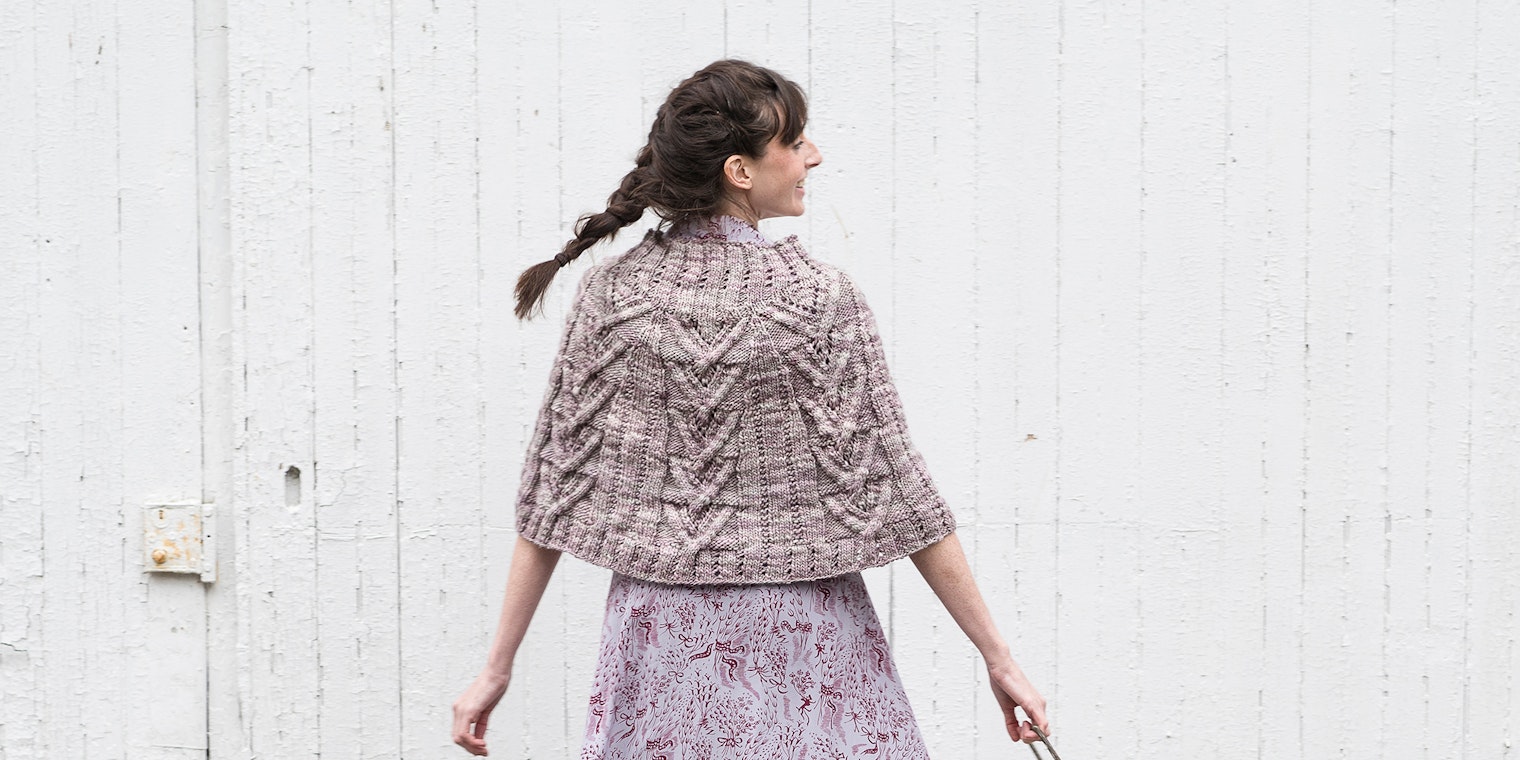
The weather is warm, and my thoughts turn to lightweight and portable knitting. Any garment that is constructed in a single piece appeals to me—I don’t want to have to think about complicated shaping or multiple components when I am knitting poolside, or in my backyard, or on the go. In the words of Elizabeth Zimmermann in Knitter’s Almanac, “Try a shawl. Do not scoff; it is perfect travel knitting . . . A round shawl, in fine wool, on a circular needle is my invariable companion when space is limited, waiting around probable, and events uncertain.”
Elizabeth’s words ring true to me, but the shawl of choice in that book is round; I generally gravitate towards rectangular wraps, but I have so many. I was delighted to see the lovely Chill Chaser Poncho by Deborah Newton in Farm & Fiber Knits, and it immediately went up to the top of my queue. It fits Elizabeth Zimmermann’s criteria for vacation knitting—it is knit in the round, and mine—it is pretty, yet not too complicated for knitting beach or poolside. It also made me think about all of the other types of shoulder coverings that there are, so I dug a little to find out more.
There are so many shoulder-covering styles that have been adopted by different cultures throughout the world, and although there is some overlap from one country to the next, there is also a great variety. Most knitters are familiar with the more common shapes throughout history (although some were woven or made of lace): triangular (including Shetland half-hap and Icelandic three-cornered shawls), rectangular (including the Ethiopian netela, the argons of the Hajongs from India and Bangladesh, and Mexican serapes), square (including the Estonian Haapsulu sal and the Spanish mantóns de Manila), and the butterfly (including the traditional Faroese shawl). For the most part, it seems that round, semicircle, and crescent came on the scene in the mid-nineteenth century. I was intrigued, and I wanted to see what else was out there.
What I learned is that the shawl is a garment that has been around for centuries in one form or another in almost every culture around the world. However, the knitted shawl seems to be a more recent development, as most early shawls were woven or made of fur.
There is much ambiguity in the definitions of these wraps, and in fact, many of the definitions rely heavily on the use of the word cloak, which itself is defined by Merriam-Webster as a loose outer garment.
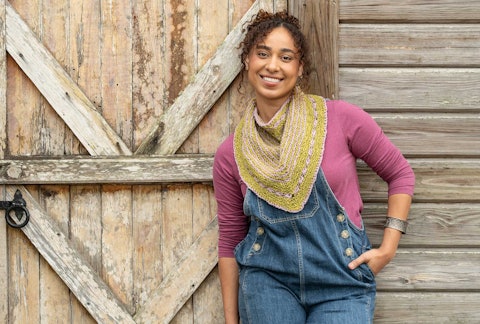
 Lori Steinberg’s Grand Picot Chunky Scarf from Farm & Fiber Knits could be worn as a scarf, or as a crescent shawl, as shown here.
It seems as though there is a loose consensus that a cape is a garment that widens from the fitted neck down and that is usually open in the front, and a poncho is a sizeable piece of fabric (usually but not always square—the Chill Chaser Poncho is a cloche/bell shape) with a hole in the center for the head opening. A wrap is often rectangular, and shawls come in all shapes and sizes. Stoles seem to be primarily rectangular, with a closure in the front. A ruana is a square or rectangle with an opening for the head and a slit all the way down the front. Cloaks seem to have hoods more often than capes do, but even that does not seem consistent.
 Seth Richardson’s Turnout Shawl from Farm & Fiber Knits is a satisfying knit and versatile garment.
And, then there are the versions with the more unusual names. Did you know that:
The Chill Chaser Poncho is aptly named a poncho, as the opening is in the middle of the garment. That is a construction feature I really like (no fussy openings to contend with)—and since the cast-on edge is at the bottom, the rounds become progressively smaller and quicker to knit, which is a win! The length is easily adjustable—if I were to make it a little shorter, I wonder if it would qualify as a bertha? I may not know what to call my favorite kind of vacation knitting, but I know that I will be happy to knit the Chill Chaser Poncho during those bright summer evenings and that it will keep me nice and warm when the weather turns cooler.
Pat Olski is the editor of PieceWork.
More from Farm & Fiber Knits


Comments
No comments yet — be the first to share your thoughts.
Sign in to join the conversation — commenting is for signed-in members.