
Loading the latest stories…
SUBneckline
Are your sweater sleeves too long? It might actually be a stretched neckline to blame! Learn how to diagnose this common fitting issue, and get Kate’s 10-minute neckline fix that could save your handknit with a nearly invisible finish.
Kate Larson3 min read
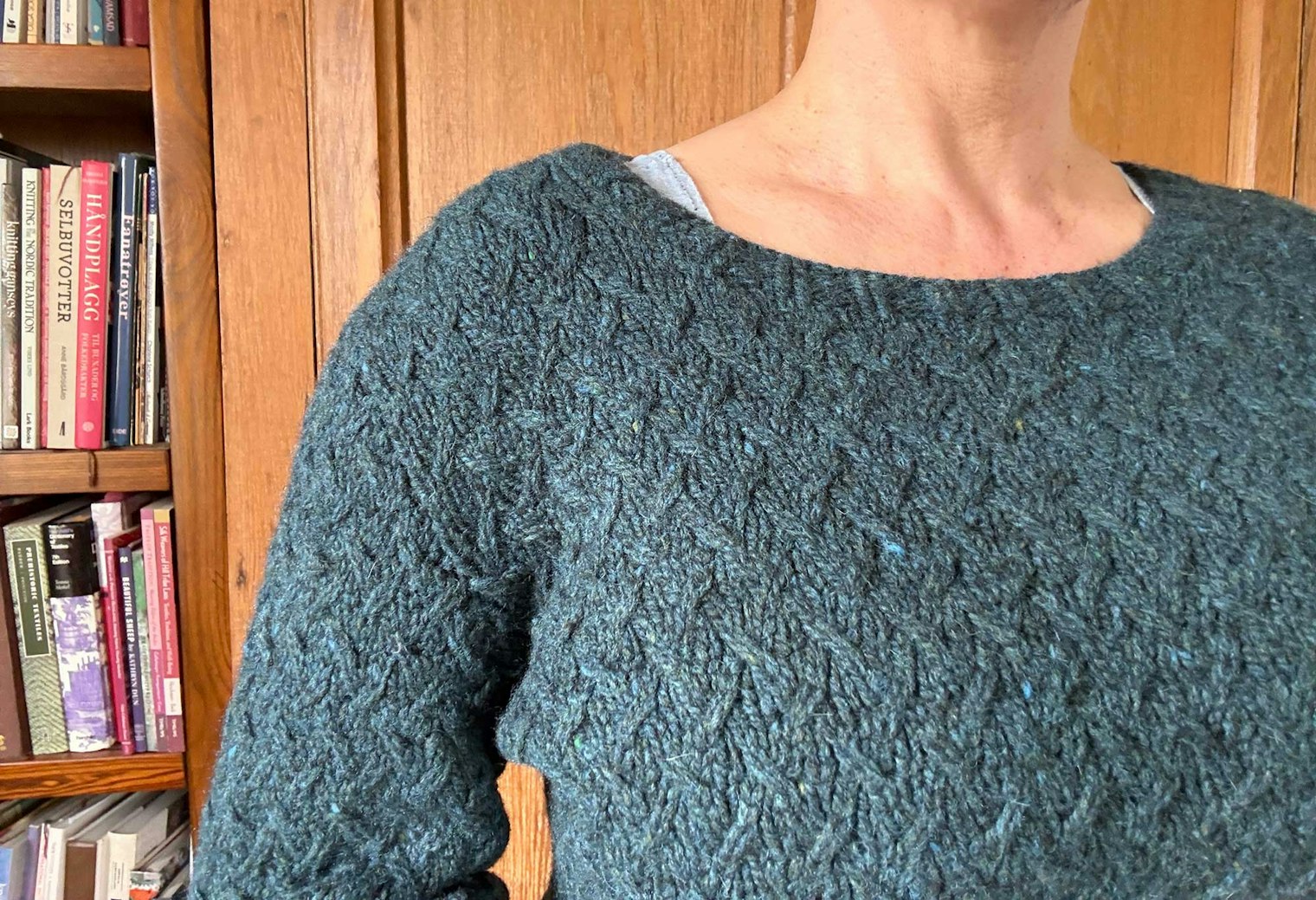
Last week, my fellow editor Pamela published a tutorial on securing necklines using tapes and ribbons. This week, I want to share an alternative method for reinforcing the back necklines of your handknits.
In about 2007, early in my knitting life, I was working at a great LYS and surrounded by busy knitters. Top-down, seamless sweaters were all the rage . . . and sagging shoulders abounded. As I spent time putting shop sample sweaters back on the hangers they slipped off of, I had a chance to look at how different sweater styles knitted in different types of yarns stretched. Seams add structure, but so does fabric density (more stitches per inch) and crimpy wools with memory. I noticed that even seamed sweaters sometimes needed a little help in the neckline where you can imagine the weight of a sweater resting on a hanger. (I’ll show you this in a minute.)
I started reinforcing the back necklines of my handknits, and it continues to be one of my top tips for improving the fit of sweaters.
To show you how easily this extra support can be added, I pulled a sweater from my collection that didn’t have a reinforced neckline (yet) to demo step by step. My go-to technique is a simple crochet chain that can be a nearly invisible addition when worked in the same yarn as the sweater, or it can be a way to add a fun pop of color. Whether you try securing necklines using tapes and ribbons or using my method, I hope you’ll give one of these techniques a try!
Set-in shoulders typically have a scooped armhole that allows the sleeve cap to be sewn into a tailored, smooth shoulder line. The sweater shown above has seams on the tops of the shoulders as well as the armhole. Nice and secure, right? Those areas are, but when I wear the sweater, the back neck stretches. When this happens, the nicely curved back neck becomes shallow and flattens, adding several inches of length to the sleeves and creating bulges above the bust. I can see the armhole seam creeping down my arm so it no longer sits at the top of my shoulder, and it looks more like a drop shoulder.
 The back of Kate's sweater on a hanger: (Left) As originally designed, this sweater has a high neck with a nice back-neck curve. (Right) As the back neck stretches, the back-neck curve becomes long and shallow, allowing the shoulders to slip lower on the arms. This changes the fit in both sleeves and bust.
This is such an easy fix! All you need is:
- 10 minutes
- A few feet of yarn
- Crochet hook
More from Farm & Fiber Knits
 Sagging Shoulders? Ways to Reinforce a Neckline | Part 1Reinforcing the neckline of a sweater can add support to the entire garment, helping it to look better longer. It’s not only practical—it’s an opportunity to add a flourish to the finish.Pamela K. Schultz · March 25, 2026
 Behind the Design: How the Fae Garland Cowlette Came to LifeLooking for your next quick, wearable knit? Designer Safiyyah Talley has great tips to make this summer project your own.Farm & Fiber Knits Editors · July 13, 2026
 Knitting with Wild Silk: Cast On With MeTraveling from forests in Madagascar to dyepots in Rwanda to store shelves in Texas, handspun borocera silk yarn has an incredible story. How does it knit up? Kate Larson · July 9, 2026
 Project Knitwell: More Than a Knitting LessonSharing knitting one hospital waiting room at a time, this Project Knitwell volunteer offers more than a new skill, creating moments of connection, comfort, and so much more.Christine McGovern · July 6, 2026
 Rooted in Place: Designing the Field Lines Shawl with Small-Farm YarnDiscover the farm yarns and rural landscapes behind the Field Lines Shawl—then cast on your own version.Shaina Scott · July 1, 2026
 Tutorial: Easy Icelandic Bind-Off for a Stretchy EdgeWhen a standard bind-off edge just isn’t stretchy or substantial enough, try this must-know technique!Kate Larson · July 1, 2026
 Stripes! Antique Welsh Socks and the Perfect Jogless JogDid you know that Welsh handknitters were known for stripy socks? Check out some wild stripes from the 19th century, learn about a modern Welsh sock yarn, and try a few techniques for perfect jogless stripes. Kate Larson · June 26, 2026
 5 Breathable Yarns for Cool Summer KnittingIf rising temperatures have you setting aside your knitting, these linen- and silk-based yarns may change your mind.Sandi Rosner · June 22, 2026
 Travel Essentials: Knitting Toolkits for Packing LightWhether traveling near or far, a few prepacked knitting notions makes knitting on-the-go a breeze. Get organized with this list of essentials, an expansion pack, a tiny emergency stitch kit.Kate Larson · June 18, 2026
 Two More Portland Trailblazers You Should KnowIn Part 2 of our series, discover how two talented fiber artists are helping shape Portland’s natural-fiber community.Emily Lymm · June 17, 2026
From the Library

Comments
No comments yet — be the first to share your thoughts.
Sign in to join the conversation — commenting is for signed-in members.