
Loading the latest stories…
Mary Jane Mucklestone shows us around Tarndie and invites us to knit along.
Mary Jane Mucklestone5 min read
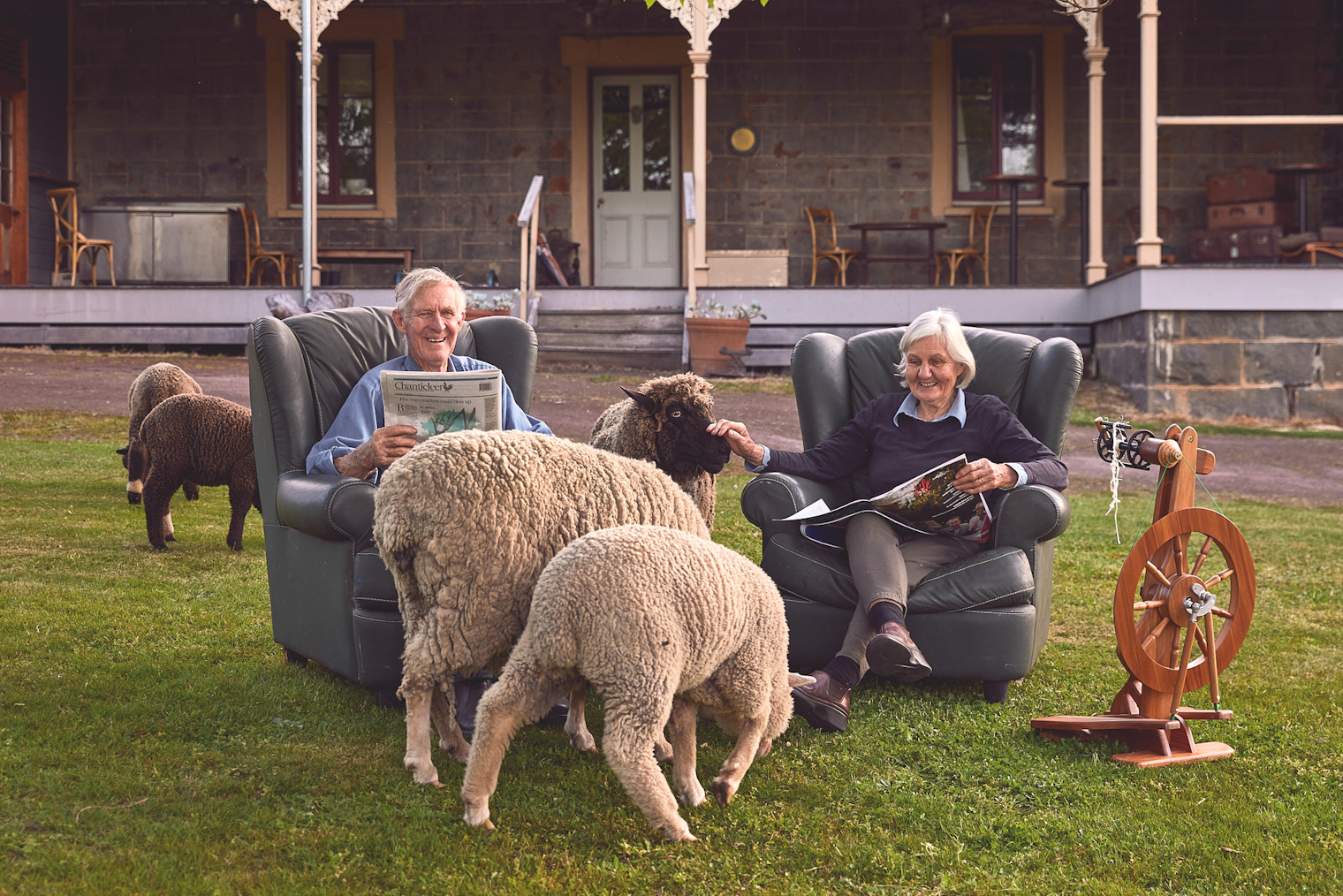
Earlier this year, I was lucky enough to visit and have the chance to teach at Tarndwarncoort Homestead, a heritage farm nestled in the heart of the Otway region in southwest Victoria, Australia. The Dennis family has been raising sheep on this land since the 1840s, making “Tarndie” one of Australia’s oldest continuously operated family-owned wool farms.
The term Tarndwarncoort translates to “up and down like a bandicoot running” in the language of the Gulidjan people, who are the traditional owners of the land. For those of us unfamiliar with the term, a bandicoot is a marsupial mammal with a distinctive galloping gait.
Today, Tarndwarncoort Homestead reflects generations of hard work and adaptability. It remains very much a family affair. Seventh-generation Tom Dennis considers himself more of a steward of the homestead than an owner, and he works alongside parents Wendy and Dave who are sill involved in the farm’s daily operation.
 Tarndie stables, which have been converted into lodging, at Tarndwarncoort Homestead in Victoria, Australia.
The Dennis family developed Australia’s first sheep breed, the Polwarth, in the 1880s. When their flocks were struggling in the damp conditions of the Otways, they recognized the need for a type of sheep better suited to the local environment. They crossed their Saxon Merinos, originally from Tasmania, with local Victoria Lincolns.
After several generations of crosses, the Dennises had a 75/25 “comeback” flock that produced a sturdy, dual-purpose breed valued for both wool and meat. The Australian Sheep Breeders Association officially recognized the Polwarth sheep as a fixed breed in 1919.
Learn more about comeback breeds, including Polwarth and Targhee.
Polwarths are easy to handle due to their docile nature. Ewes are known as exceptional mothers and can lamb at all times of the year. Their smooth, wrinkle-free skin eliminates the need for the controversial practice of mulesing (removing strips of wool-bearing skin from the rear region of a live lamb to prevent flystrike). The wool is exceptional. Today, the Polwarth’s abundant fleece has a micron count between 20 and 24 and a staple length between 4 and 5 inches (10 and 13 cm). Although most Polwarth fleece is classified as fine, it is suitable for beginning spinners and is treasured by experts. At Moorpark Farm (which is next door to Tarndwarncoort), Tom’s brother Al raises the family’s Polwarth sheep, which descend directly from their ancestors’ original flock.
In the 1970s, when Wendy taught herself to spin, she became interested in natural-colored fleece. Though Polwarth sheep have historically been selected to be bright white, Wendy and Dave worked diligently to develop a range of naturally colored fleece, including blacks through browns and a lovely range of grays.
While farm folk of the area had always spun their own wool and knitted, the wider world was experiencing a revival in these traditional crafts, and the natural-color shades of Tarndie’s Polwarth fleeces became especially coveted. At present, nearly half the flock is made up of naturally colored fleeces.
More from Farm & Fiber Knits
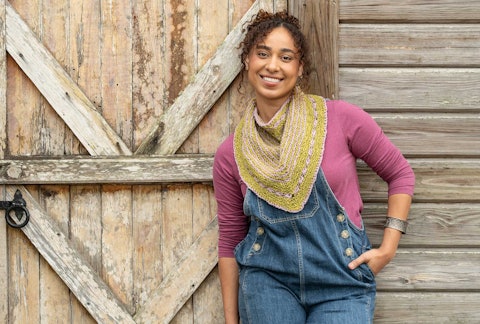 Behind the Design: How the Fae Garland Cowlette Came to LifeLooking for your next quick, wearable knit? Designer Safiyyah Talley has great tips to make this summer project your own.Farm & Fiber Knits Editors · July 13, 2026
 Knitting with Wild Silk: Cast On With MeTraveling from forests in Madagascar to dyepots in Rwanda to store shelves in Texas, handspun borocera silk yarn has an incredible story. How does it knit up? Kate Larson · July 9, 2026
 Project Knitwell: More Than a Knitting LessonSharing knitting one hospital waiting room at a time, this Project Knitwell volunteer offers more than a new skill, creating moments of connection, comfort, and so much more.Christine McGovern · July 6, 2026
 Rooted in Place: Designing the Field Lines Shawl with Small-Farm YarnDiscover the farm yarns and rural landscapes behind the Field Lines Shawl—then cast on your own version.Shaina Scott · July 1, 2026
 Tutorial: Easy Icelandic Bind-Off for a Stretchy EdgeWhen a standard bind-off edge just isn’t stretchy or substantial enough, try this must-know technique!Kate Larson · July 1, 2026
 Stripes! Antique Welsh Socks and the Perfect Jogless JogDid you know that Welsh handknitters were known for stripy socks? Check out some wild stripes from the 19th century, learn about a modern Welsh sock yarn, and try a few techniques for perfect jogless stripes. Kate Larson · June 26, 2026
 5 Breathable Yarns for Cool Summer KnittingIf rising temperatures have you setting aside your knitting, these linen- and silk-based yarns may change your mind.Sandi Rosner · June 22, 2026
 Travel Essentials: Knitting Toolkits for Packing LightWhether traveling near or far, a few prepacked knitting notions makes knitting on-the-go a breeze. Get organized with this list of essentials, an expansion pack, a tiny emergency stitch kit.Kate Larson · June 18, 2026
 Two More Portland Trailblazers You Should KnowIn Part 2 of our series, discover how two talented fiber artists are helping shape Portland’s natural-fiber community.Emily Lymm · June 17, 2026
 Summer Bracket Challenge—Announcing the Winner!You helped us choose the winning pattern, and now you can download it for free for a limited time.Farm & Fiber Knits Editors · June 12, 2026
From the Library



Comments
No comments yet — be the first to share your thoughts.
Sign in to join the conversation — commenting is for signed-in members.